











Shift 3: Loving-Awareness Cultivates Freedom From Suffering
In Shift 3 of the Let Go to Flow series, Sol Hot Yoga explores how hot yoga for loving-awareness helps turn emotional awareness into embodied practice. Through Sol Hatha and Sol Vinyasa, students learn to name what they feel, meet fear with presence, and practice from courage instead of force. This shift is not about denying difficulty or performing perfect postures. It’s about remembering what is real beneath the pattern: Loving-Awareness.
Shift 1 brought awareness to suffering. We stopped fighting the symptom and began to see the pattern.
Shift 2 deepened awareness through inquiry. We learned to ask better questions and let suffering become the teacher — our inner guru. The Shift 2 article used a practical table to show how old questions can become conscious questions.
Shift 3 begins with knowing.
Not intellectual knowing. Not another identity. Not another spiritual concept to carry.
A deeper remembering.
What is real is Loving-Awareness.
The Problem: Emotional Awareness Without Embodiment
Awareness alone doesn’t always change us.
We can see the pattern. We can ask better questions. We can name the trap, identify the trigger, and even speak the language of presence, witness, and inner teacher.
And still, the old pattern can return.
Not because the awareness is wrong. Not because the inquiry is shallow. But because seeing is not the same as becoming.
Insight without embodiment can become another kind of identity.
We become the person who understands.
The person who has read the books.
The person who knows the teachings.
The person who can explain the pattern.
But the pattern still runs.
This is the most subtle trap in the series so far.
The ego learns the language of letting go and uses it to perform. The student studies the way of the witness but never steps fully into practice.
We mistake:
“I understand it”
for
“I have become it.”
That distinction matters.
Because yoga is not simply something we understand.
Yoga is something we practice until it becomes embodied.
The Cost: Unnamed Emotion Becomes Force
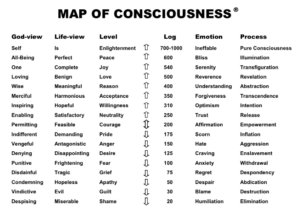
Dr. David R. Hawkins’ Map of Consciousness from Power vs. Force (1995). Emotions below 200 (Courage) operate as force — pushing, defending, controlling. Emotions at and above 200 operate as power — receptive, integrative, free.
The cost is not simply that we feel bad.
The deeper cost is that unnamed suffering becomes force: it drives, pushes, defends, controls, reacts, and repeats itself because it has not yet been brought into awareness.
The cost of leaving emotion unnamed is that it often remains unconscious.
And what remains unconscious can quietly direct our reactions until those reactions begin to feel like identity.
This is where suffering becomes force.
Force pushes.
Force defends.
Force controls.
Force reacts before love has a chance to respond.
In our practice, force often begins with unnamed suffering.
We feel fear, but call it urgency.
We feel shame, but call it discipline.
We feel grief, but call it fatigue.
We feel anger, but call it truth.
We feel insecurity, but call it ambition.
We feel control, but call it care.
Because the emotion remains unnamed, it keeps operating beneath the surface.
Then we act from it.
We grip tighter.
We push harder.
We compare more.
We defend faster.
We collapse sooner.
We repeat the same pattern and wonder why nothing changes.
This is the cost of not asking the better questions from Shift 2, where we practiced moving from fear-based questions into conscious inquiry.
Instead of asking, “What pattern is being repeated right now?” we ask, “Why is this happening to me?”
Instead of asking, “Can I notice this without becoming it?” we ask, “What’s wrong with me?”
Instead of asking, “Does this come from love or fear?” we let fear answer before love has a chance to speak.
That is the cost.
Force is what happens when fear has not yet been met with awareness.
And once fear is met with awareness, the shift can begin.
Modern psychology gives language to one part of this practice. Researchers call it affect labeling — putting feelings into words. In Matthew Lieberman’s research at UCLA, labeling emotional images was associated with increased prefrontal cortex activity and reduced amygdala activity, suggesting that naming emotion may help reduce emotional reactivity.
That doesn’t mean naming emotion makes pain vanish.
It means naming emotion brings the feeling into awareness.
And what enters awareness can begin to soften.
The Correction: The Peaceful Warrior’s Return to Loving-Awareness
The correction is not to force the emotion away.
The correction is to begin by remembering what is real.
Fear may be present, but fear is not the deepest truth.
The ego may feel vulnerable, but the ego is not the deepest self.
The pattern may appear again, but the pattern is not your fundamental nature.
What is real is Loving-Awareness.
Ram Dass taught it this way: “I’m aware of my thoughts, but loving-awareness is simply witnessing them. And loving-awareness is in the moment.” Loving-Awareness is awareness with the heart open — present to whatever arises, our own or another’s suffering, without being drawn into it.
Patañjali pointed to the same union with the divine, and named four qualities our practice cultivates within: loving-kindness (mettā), compassion (karuṇā), sympathetic joy (muditā), and equanimity (upekkhā). These are the divine qualities of loving-awareness that abide deep within our soul, and each one can emerge to meet the present moment.
| When we meet… | The old self reacts with… | The practice cultivates… |
|---|---|---|
| Our own difficulty | Self-criticism | Loving-kindness (Mettā) |
| Suffering — ours or another’s | Hardening or avoidance | Compassion (Karuṇā) |
| Another’s strength or success | Comparison or envy | Sympathetic joy (Muditā) |
| Pleasure and pain alike | Grasping or aversion | Equanimity (Upekshā) |
That is where this shift begins.
Your yoga practice is an opportunity to step into the stillness of your fundamental nature — wide awake, consciously courageous, and rooted in abundant love.
You don’t have to shame the fear.
You don’t have to deny the grief.
You don’t have to overpower the anger.
You don’t have to pretend you’re above the insecurity.
You begin by naming it.
This is fear.
This is grief.
This is shame.
This is anger.
This is longing.
This is control.
Not as a verdict.
As a doorway.
Because once the feeling is named, it is no longer hidden in the dark. It has entered awareness. And what enters awareness can begin to soften.
This is the shift from reaction to response.
From unconscious momentum to conscious choice.
From fear driving the pattern to awareness meeting the pattern.
This is the path of the Peaceful Warrior.
Not fighting the self.
Not defeating the body.
Not forcing the mind into silence.
But meeting fear with awareness until force begins to soften into freedom.
On Your Mat: Name, Meet, Choose
In class, when difficulty arrives, pause inwardly.
Ask:
What feeling is present right now?
Then name it:
This is fear.
This is frustration.
This is comparison.
This is shame.
This is uncertainty.
Then ask:
Can I meet this with Loving-Awareness?
In Sol Hatha, you may meet force as the urge to grip, strain, endure, or prove yourself in the posture. When you name what is happening — this is fear, this is comparison, this is resistance — the posture becomes a place to practice Loving-Awareness. You soften your jaw, steady your breath, feel your feet, and stay without violence.
In Sol Vinyasa, you may meet force as the urge to rush, compete, chase the next shape, or control the pace of practice. When you name the pattern, movement becomes a place to return: one inhale, one exhale, one transition, one conscious choice.
The conditions may still be hard.
The posture may still feel impossible.
The mind may still offer its escape routes.
But now you are not just witnessing the pattern.
You are naming what is here.
You are meeting fear with awareness.
You are choosing from what is real.
That is where force begins to become freedom.
Wrap-Up: The Three Shifts To Let Go & Flow
A bit of modern spiritual folklore tells of a young child whose parents bring home a newborn baby. The older child asks to speak with the baby alone. Curious, the parents listen quietly outside the door. They hear the child whisper, “Tell me where you came from. Who made you? I’m beginning to forget.”
Whether literal or symbolic, the story points to something tender and true: the spiritual path is not always about adding something new.
Sometimes it’s about remembering what fear, conditioning, and identity have caused us to forget.
The three shifts help us remember:
- When we notice a posture is challenging:
- Shift 1 — What You Resist Will Persist: “Am I fighting this, or learning from it?”
- Shift 2 — What You Repeat Runs Deep: “Who is the one that needs this posture to be different?”
- Shift 3 — From Force to Freedom: “Can I name my vulnerability, and know Loving-Awareness will transcend it?”
- When we notice a season of life is transitioning:
- Shift 1: “What am I resisting because I’m afraid to let go?”
- Shift 2: “What is being pruned for new growth to emerge?”
- Shift 3: “Can I meet uncertainty with Loving-Awareness?”
- When we notice the body is changing:
- Shift 1: “Can I meet this body with less judgment and more honesty?”
- Shift 2: “What qualities in me will emerge to transcend the change?”
- Shift 3: “Can I remember that Loving-Awareness transcends physical form?”
- When we notice emotions feel overwhelming:
- Shift 1: “What feeling am I resisting right now?”
- Shift 2: “Does this feeling come from a place of love or fear?”
- Shift 3: “Can this feeling be named, held, and allowed to flow through me with Loving-Awareness?”
Shift 1 taught us:
What you resist will persist.
Shift 2 taught us:
What you repeat runs deep.
Shift 3 reminds us:
What is real is Loving-Awareness.
What is real is the authentic love that supports awareness. That love is free of colorings (kleshas), and free of action-reaction (karma-vipaka).
Pure Loving-Awareness transcends.
This is the doorway from force to freedom.
Not by pretending life is easy.
Not by denying difficulty.
Not by performing spirituality.
But by practicing the return to your fundamental nature.
And when you remember what is real, you carry it differently.
You let go to flow.
Practice With Sol Hot Yoga: The Home of The Peaceful Warriors
Ready to bring this practice into your body?
Join us at Sol Hot Yoga Studio in Carmel or Zionsville for Sol Hatha, Sol Vinyasa, and hot yoga classes designed to help you build strength, steadiness, courage, emotional awareness, and presence.
You don’t have to be flexible to begin.
You only need a place to start.
Step into practice. Step into stillness. Let go to flow.
